Historical Manuscripts Relating to the Invention of the First Balloon and its Maiden Flight in Lisbon, on August 8, 1709. Synopsis of the Portuguese Original with English and German Translations.
Edited by Marietta Benkö and Bernhard Schmidt-Tedd in cooperation with Denise Digrell. Translations by Abilia Scheidl, Peter Kertész and Marietta Benkö. Cologne 2002
This manuscript is about the first balloon flight in the history of aviation (even before the Brothers Montgolfier) by Bartholomeu Lourenço de Gusmão, whereby the invention was subsidised and patented by King João I in 1709. (The manuscript reveals the first patent in aviation history!)
In this connection it is interesting to see that Gusmão foresaw the use of aircraft not only for general transportation, but crucially, for strategic and military advantage. This point is clearly made in his petition to the King, in which he requested subsidies to realise his project and set out its usefulness for the Crown.
Of course, it must be taken into account that the concept of aerial warfare predates Gusmão's invention, having featured in legends and myths for centuries. Take, for instance, Hieronymus Bosch's triptych from 1500, which remarkably foreshadows modern airborne combat.
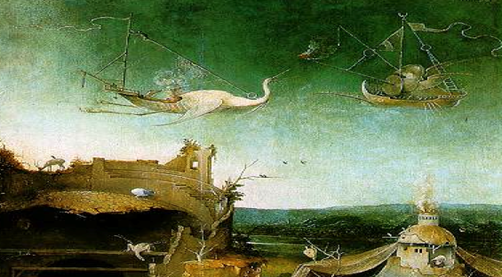
Excerpt from the middle panel of the triptych „The Temptation of Saint Anthony“ by Hieronymus Bosch (painted between ca. 1495-1515. (Picture retrieved from Wikimedia Commons )
Thus, the concept of 'dual use' in aviation has not only been in the minds of men for ages but can also be traced back to the earliest days of flight technology in the context of modern realism.
As for the fate of Gusmão's pioneering work, he tragically fell victim to ignorance and superstition. He was persecuted for heresy by the Holy Inquisition for his experiment and his 'Manifesto to those who do not know that the element of air can be navigated', and was forced to renounce his invention to avoid execution.